

Have you ever wondered how the phone case in your hand, the TV remote at home, or even the keyboard in your office were made? Most likely, these everyday items were manufactured using a technology called "plastic injection molding." This technology may seem unassuming, yet it has quietly transformed how the objects around us are manufactured — like the unsung heroes behind the scenes, understated yet critically important.
In Taiwan, manufacturing has always been the economic lifeline, from the early days as an "OEM kingdom" to today's status as a "precision manufacturing hub" — plastic injection molding technology has been instrumental throughout. This technology is like an invisible driving force behind Taiwan's manufacturing industry, securing our place in the global supply chain.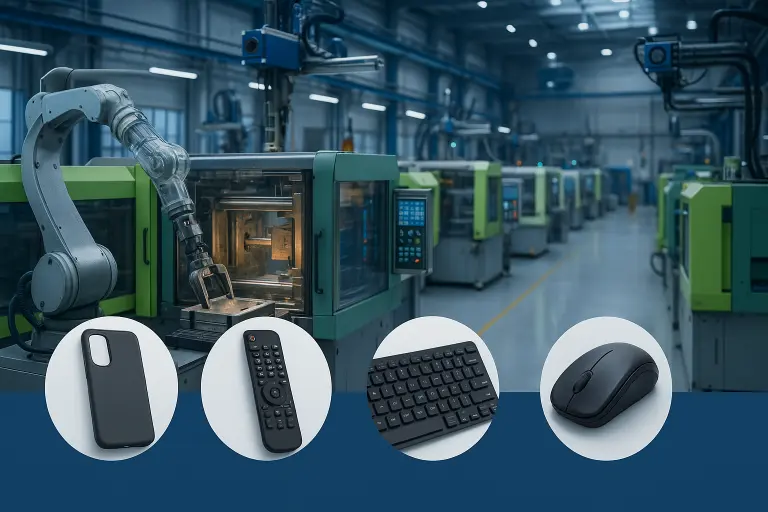
The Evolution of Manufacturing Precision: From Rough to Refined
Think back to plastic products from ten or twenty years ago — weren't they often plagued by burrs, visible seams, and prone to breaking after just a little use? Back then, plastic injection molding technology was still in a relatively early stage. Now look at the cases of your smartphone or high-end electronic products — surfaces are smooth and refined, seams are virtually invisible, and the feel has greatly improved. This is the best proof of how plastic injection molding technology has evolved.
Over the past decade, plastic injection molding technology has reached several important milestones: breakthroughs in micro-foaming technology, the popularization of multi-material co-injection molding, the application of smart molds, and the introduction of high-precision control systems. These technological advances have transformed plastic injection molding from simple "plastic injection" into a sophisticated combination of "materials science" and "engineering art."
Previously, making a complex-shaped component might have required manufacturing multiple simple parts first, then assembling and bonding them together. Now, through advanced plastic injection molding technology, many complex components can be formed in a single cycle — like condensing what used to require five or six processes into one step, with obvious efficiency gains.
For example, manufacturing an electronic product housing with internal structures used to require separate production of the outer shell and internal supports, followed by assembly. Now, through advanced mold design and injection molding technology, these complex structures can be completed in a single injection process — not only eliminating assembly time but also improving the product's overall strength and precision.
.webp)
Key Advantages of Modern Plastic Injection Molding: A Win-Win of Efficiency and Quality
Astonishing Production Speed
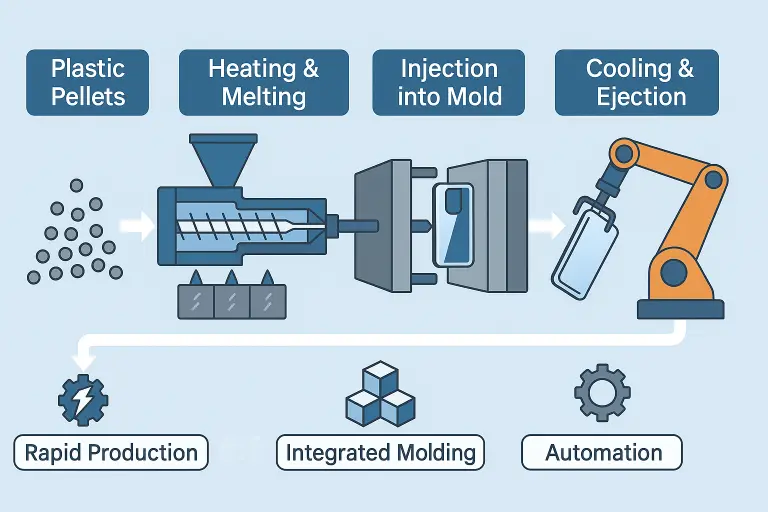
In manufacturing, time is money — and that is no exaggeration. The production speed of plastic injection molding is, frankly, sometimes hard to believe. A small plastic component's production cycle may take only a few seconds to tens of seconds, medium components about 30 seconds to 2 minutes, and even larger components just 2 to 5 minutes. Compared to traditional machining or manual production, this efficiency is like comparing high-speed rail to a bicycle.
Imagine needing to produce 100,000 phone cases — traditional methods might take weeks or even months, but with plastic injection molding, it could be done in a single day. This high efficiency is reflected not only in production speed but also in reduced setup time and lower labor requirements. An automated injection molding production line may need only 1-2 operators to monitor, maintaining 24-hour uninterrupted production.
Complex Designs Are No Longer a Challenge
Another impressive capability of plastic injection molding technology is its ability to realize complex design concepts. Previously, designers might have had to simplify product designs due to manufacturing limitations — now they can boldly envision all kinds of complex shapes.
Take the common computer mouse as an example — its ergonomic curved shape, multi-layered internal structure, anti-slip surface texture, and even the combination of transparent and opaque materials are all achievements of plastic injection molding technology. This technology can precisely replicate every detail of a designer's vision, as if directly materializing thoughts from the mind.
Interestingly, plastic injection molding can also create "invisible" internal structures. Like the toys you might buy at a night market — seemingly simple on the outside, they may hide complex internal mechanisms, all formed during a single injection process. This capability opens up more design possibilities for products and brings consumers a better user experience.
Diverse Material Choices: Combining Strength and Functionality
Modern plastic injection molding is no longer limited to a single type of plastic material. From common ABS, PP, and PE to engineering plastics like PC and POM, to specialty functional materials like conductive plastics, flame-retardant materials, and even biodegradable plastics — the selection is dazzling.
This material diversity means manufacturers can choose the most suitable material based on product requirements. Need a heat-resistant component? There is a dedicated material. Need a high-strength but lightweight structure? There is a corresponding solution as well. It is like shopping at a night market — no longer just "one size fits all" but being able to find exactly what meets your needs.
Multi-material injection molding technology takes this flexibility to the next level. Imagine a product where the grip uses a soft material for comfort while the structural portion uses a rigid material for strength — these different materials can be combined in a single injection process to form one integrated piece. This technology is widely applied in medical devices, consumer electronics, and automotive components.
Quality Control: From Visual Inspection to Smart Monitoring
In the manufacturing process, quality control has always been a critical element. Traditionally, this might have relied on manual sampling inspection, but modern plastic injection molding has entered the era of smart manufacturing.
The introduction of industrial machine vision camera systems has fundamentally changed the approach to quality control. These high-resolution, high-speed imaging systems can perform real-time inspection simultaneously with production, capturing tiny defects that the human eye might miss. The system automatically analyzes each product's dimensions, shape, surface quality, and other parameters to ensure they meet preset standards.
This 100% inspection capability not only improves product consistency and reliability but also significantly reduces scrap rates. Imagine if 1% of a batch were defective — in mass production, that could mean thousands of scrapped units. Through real-time inspection and adjustment, this rate can be reduced to 0.1% or even lower, with considerable cost savings.
More importantly, the data collected by these systems can be used for continuous production process improvement. By analyzing defect patterns and trends, engineers can identify and resolve potential issues, further improving production efficiency and product quality. It is like having an tireless quality expert watching the production line 24 hours a day, providing improvement suggestions at any time.
.webp)
Cost-Benefit Analysis: Short-Term Investment for Long-Term Returns
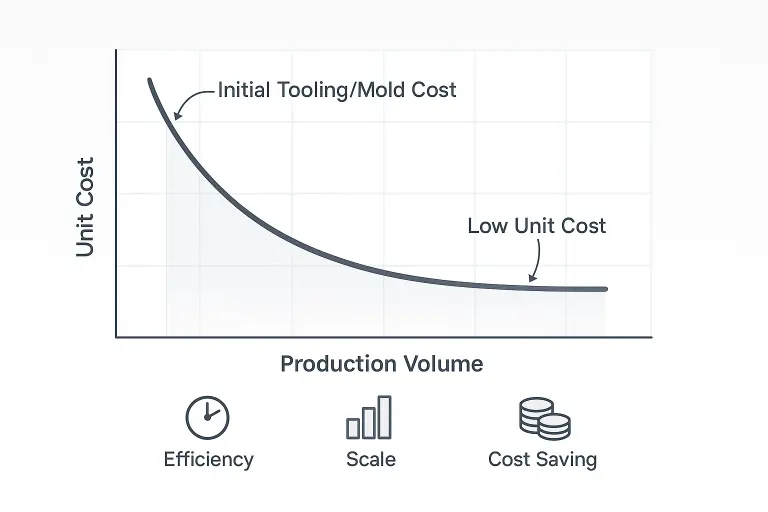
When it comes to plastic injection molding, one topic that must be addressed is cost. Many people may be intimidated by the initial mold investment, as a set of high-quality injection molds can cost hundreds of thousands or even millions of New Taiwan Dollars. But this is like the difference between buying and renting a house — it seems costly in the short term, but it is quite a worthwhile investment in the long run.
When production volume reaches a certain scale, the cost per component drops dramatically. Taking a small plastic product priced at NT$50 as an example — if the mold cost is NT$500,000, then producing 10,000 units means each product bears a mold cost of NT$50. But if you produce 100,000 units, that cost drops to just NT$5. Combined with plastic injection molding's high efficiency and low labor requirements, overall production costs decrease significantly as volume increases.
Beyond direct production costs, plastic injection molding can bring savings in other areas as well. For instance, because product consistency is high, subsequent assembly and testing processes run more smoothly, reducing the need for rework and adjustments. Additionally, since complex integrated designs can be achieved, the number of parts and assembly steps is reduced, further lowering production and inventory management costs.
Not to mention that high-quality products mean fewer customer complaints and returns — these hidden cost savings are often overlooked but are crucial for long-term business development.
Common Challenges and Solutions: Technical Difficulties Are No Longer Stumbling Blocks
Of course, plastic injection molding technology is not without challenges. Mold design is a technically demanding process that requires consideration of product structure, material flow, cooling efficiency, and many other factors. A poorly designed mold can lead to product defects, low production efficiency, and even premature mold damage.
Material selection is also an area requiring specialized knowledge. Different plastic materials have different flow characteristics, shrinkage rates, and mechanical properties — selecting the wrong one could result in products failing to meet expected performance requirements.
Production scheduling and maintenance management are equally important. Injection molding machines require regular maintenance to ensure stable performance, while rational production scheduling can maximize equipment utilization, reducing energy consumption and production costs.
To address these challenges, Taiwan's manufacturing industry has developed a mature set of solutions. Professional mold design software and mold flow analysis tools help engineers predict and resolve potential issues before actual production. Material suppliers provide detailed technical data and application recommendations to help manufacturers select the most suitable materials. Advanced production management systems optimize production scheduling, ensuring efficient equipment operation and timely maintenance.
Transitioning to Plastic Injection Molding: A Five-Step Evaluation Method
For enterprises considering adopting plastic injection molding technology, a systematic evaluation process is essential. This process can be divided into five key steps:
The first step is production volume assessment. Plastic injection molding is best suited for medium to large-batch production. If your product's annual output is below 1,000 units, you may need to consider other manufacturing methods — unless the product structure is particularly complex or has special requirements.
The second step is part design review. Evaluate whether the product design is suitable for plastic injection molding, including wall thickness uniformity, draft angles, and rib design. Sometimes, a slight design adjustment can dramatically improve production efficiency and product quality.
The third step is material selection. Choose appropriate materials based on product functional requirements, operating environment, and budget constraints. It is best to consult material experts or suppliers for recommendations at this stage.
The fourth step is quality requirement analysis. Clearly define the product's key quality parameters and allowable tolerance ranges to ensure the plastic injection molding process can meet these requirements.
The final step is cost-benefit calculation. Comprehensively consider mold investment, material costs, production efficiency, and labor requirements. Calculate the unit cost at different production volumes and compare with other manufacturing methods.
This evaluation process may seem tedious, but it helps enterprises make informed decisions and avoid unnecessary investment risks. Just like inspecting a house's location, layout, and price before buying, a comprehensive evaluation before investing in plastic injection molding technology is the key to success.
Mastering Manufacturing Quality: From Reactive Inspection to Proactive Prevention
In today's competitive market environment, product quality is often a company's lifeline. One important advantage of plastic injection molding technology is its ability to achieve highly consistent quality control.
Traditional quality control methods were often "post-production inspection" — sampling products after completion, then adjusting production parameters after discovering problems. This approach is not only inefficient but can also lead to large quantities of non-conforming products.
Modern plastic injection molding employs a "full-process monitoring" approach. From material feeding, heating and melting, injection molding, to cooling and demolding — every stage has precise parameter control and real-time monitoring. Any deviation is immediately detected and adjusted, ensuring product quality consistency.
Automated inspection systems further elevate quality control to new heights. High-resolution cameras capture minute surface defects, precision measuring equipment verifies critical dimensions, and advanced data analysis systems identify potential quality trends and issues.
This comprehensive quality control not only ensures high product quality but also greatly reduces scrap rates and customer complaints, saving enterprises significant costs and time. Just like health checkups — regular comprehensive examinations can detect and resolve potential issues early, preventing small problems from becoming big troubles.
Conclusion: Plastic Injection Molding Technology and the Future of Taiwan's Manufacturing Industry
Looking back at the development history of Taiwan's manufacturing industry — from early labor-intensive industries to today's technology-intensive industries — plastic injection molding technology has consistently played an important role. It has not only improved production efficiency and product quality but has also promoted industrial upgrading and innovation.
Looking to the future, with the advancement of smart manufacturing and Industry 4.0, plastic injection molding technology will further integrate artificial intelligence, big data analytics, and Internet of Things technology, achieving even higher levels of automation and intelligence. Imagine a future injection molding factory that is fully automated — from order receipt to product shipment, the entire process coordinated by intelligent systems, with humans needed only for high-level supervision and decision-making.
For Taiwan's manufacturing industry, mastering advanced plastic injection molding technology is not only a means to enhance competitiveness but also the key to achieving industrial transformation and upgrading. Through continuous innovation and refinement, Taiwanese enterprises can occupy more favorable positions in the global supply chain and create higher added value.
If you are considering how to enhance your manufacturing capabilities or searching for more efficient and precise production methods, plastic injection molding technology is absolutely worth exploring and trying. It may require a certain initial investment, but in the long run, it is definitely a worthwhile one.
Just like learning a new skill — you may encounter various challenges and difficulties at the beginning, but once you master the core essentials, you will find it opens up an entirely new world of possibilities. In this process, choosing the right partners and suppliers and obtaining professional technical support and advice will greatly shorten your learning curve and accelerate your path to success.
Now is the time to re-examine your manufacturing strategy and explore the unlimited possibilities that plastic injection molding technology can bring. After all, in this rapidly changing market environment, technological innovation is often the key to sustained business success. And plastic injection molding technology is precisely such a powerful tool that can help you stand out from the competition.